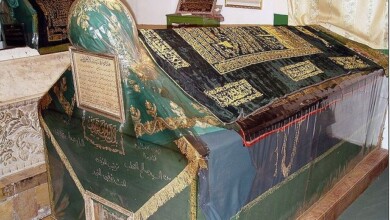

Jabir ibn ‘Abdullah al-Ansari: The Companion of the Trench and the feast
In the annals of the noble Companions, the name Jabir ibn ‘Abdullah shines with a particular light—that of unwavering loyalty, profound loss, and the tireless preservation of the Prophet’s legacy. He was Jabir ibn ‘Abdullah ibn ‘Amr from the Banu Salamah tribe of the Khazraj in Madinah.
He was born into a household steeped in faith. His mother was Nasibah bint ‘Uqbah ibn ‘Adi al-Ansariyah. His father, ‘Abdullah ibn ‘Amr ibn Haram, was a man of deep conviction who would earn the highest honour: martyrdom on the sands of Uhud.
THE PLEDGE OF ‘AQABAH AND THE DAWAH IN MADINAH
Jabir embraced Islam in its tender, early days. He was one of the six chosen from the Ansar who witnessed the first pledge at ‘Aqabah. Alongside figures like As‘ad ibn Zurarah and Rafi‘ ibn Malik, the young Jabir stood before the Prophet Muhammad (peace and blessings be upon him), heard his call, and pledged his allegiance. This small band returned to Madinah as the first seeds of dawah, working tirelessly until the message of Islam spread throughout the homes of the city.
The Prophet held a special affection for Jabir, often inquiring after his welfare with the concern of a father, guiding him with a gentle hand towards all that was good.
Jabir’s heart yearned for jihad. He eagerly sought to fight at Badr and Uhud, but his father, ‘Abdullah, enjoined upon him a different duty: to stay and care for his six sisters. It was a command of familial responsibility that Jabir obeyed, watching as his father departed for Uhud, never to return.
The martyrdom of his father transformed Jabir’s dutiful restraint into a determined resolve. From that moment, he became a constant presence in the campaigns of the Prophet, participating in no less than twenty-one battles, including the pivotal Battle of the Trench and the Pledge of Ridwan under the tree at Hudaybiyyah.
THE GUARDIAN OF THE SUNNAH
In the grand mosaic of hadith narration, Jabir’s contribution is vast and indispensable. He narrated approximately 1,540 hadiths. Of these, fifty-eight are recorded in the agreed-upon collections of both al-Bukhari and Muslim.
Al-Bukhari uniquely narrates twenty-six from him, while Muslim records an impressive one hundred and twenty-six not found elsewhere. His narrations are often vivid, first-person accounts filled with the texture of lived experience.
THE MIRACLE OF THE TRENCH
It is from the Battle of the Trench, however, that one of the most intimate and miraculous stories involving Jabir emerges—a story he himself narrated in rich detail in the Sahihayn. As the Muslims laboured under exhaustion and piercing hunger, tying stones to their bellies to numb the pain, they struck an immovable rock. The Prophet, himself suffering greatly, took up a pickaxe. With a strike, the solid rock shattered into soft sand—a clear miracle.
Moved by the Prophet’s state, Jabir sought permission to return home.
He confided in his wife about their leader’s hunger. All they possessed was a small sheep and a handful of barley. With sincere hearts, they prepared this meagre meal. Jabir then invited the Prophet, whispering of their scant provisions. The Prophet, perceiving the blessing within their sincerity, called out, “O people of the Trench! Jabir has prepared a feast for you!”
Jabir’s wife was overcome with anxiety.
How could this suffice an army? Yet, as the Prophet entered, he blessed the food and began to serve it with his own blessed hands. Companions entered in groups, ate their fill, and departed. The pot remained brimming, the bread unfinishing.
The Prophet then told Jabir and his wife, “Eat, and give to others, for the people are stricken with hunger.” In their humble home, through the barakah of the Prophet, a miracle of nourishment unfolded, feeding the entire army and leaving leftovers.
LATER LIFE
After the passing of the beloved Prophet, Jabir continued his service to the Ummah. He fought in the conquest of the Levant, was present at the siege of Damascus with Khalid ibn al-Walid and stood with the Amir al-Mu’minin ‘Ali ibn Abi Talib at Siffin.
In his later years, he settled as a revered teacher in Madinah, becoming a living bridge between the generations. Students travelled to him, seeking the priceless gems of hadith from a man who had walked, fought, and eaten with the Best of Creation.
Jabir ibn ‘Abdullah passed away in Madinah around 78 AH, having lived a life that spanned the revelation of Islam, its trials, and its zenith.