Mubaje decries costly Muslim feuds
By Ahmed Idriss
Muslims have been urged to put aside personal differences, avoid abusive language and learn to resolve disputes peacefully, with religious leaders warning that divisions have cost the community dearly.
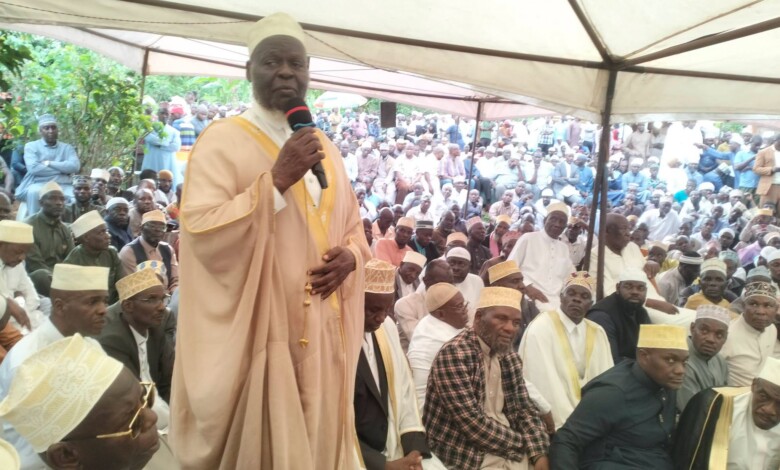
The appeal was made by the Mufti of Uganda, Sheikh Shaban Ramadhan Mubaje, through his deputy, Sheikh Muhammad Ali Waiswa, during a funeral dua for the late Sheikh AbdulQadir Mbogo, former imam of Gaddafi National Mosque.
Delivering Mubaje’s message at Kiwanga UMEA Primary School in Mukono District on Sunday, November 01, Waiswa said disagreements were inevitable, but Muslims needed to learn how to handle them without allowing them to tear the community apart.
“Disputes between us have cost Islam so much. Disputes will not end, and it is important for Muslims to learn how to manage them,” he said.
He added: “If I told you some of the things we have lost because of disputes, we would all leave this place in tears.”
Waiswa called on Muslims to recognise the Uganda Muslim Supreme Council (UMSC) as the country’s umbrella body and continue supporting its programmes, even when they disagreed with its leadership.
He also criticised the use of abusive language within the Muslim community, saying it reflected poorly on its members. He urged Muslims to draw lessons from Mbogo’s commitment to Islam and the way he handled disagreements.
“It is easy for people to deviate while thinking they are still on course,” he said, urging Mbogo’s children to remain faithful to the values their father upheld.
Waiswa said the family had the capacity to continue Mbogo’s work and preserve his legacy. He recalled listening to the late cleric’s religious programme on Radio Uganda while growing up, saying he rarely missed the Friday broadcasts.
He also paid tribute to Mbogo and the late Sheikh Ibrahim Nkangi, former Kadhi of Greater Mpigi Muslim District, for their contributions to the formation of the UMSC.
CALL TO PRESERVE MUSLIM HISTORY
The gathering also heard calls for greater efforts to document the history of Islam in Uganda and the contributions of its leading figures.
UMSC Secretary General Haji Abasa Muluubya said Mbogo’s life was closely connected to the history of the council, describing him as one of its pioneers who remained committed to the institution until his death.
Muluubya said the experiences and achievements of Muslim leaders should be recorded for future generations rather than left to fade with their passing.
He revealed that the UMSC had written to Makerere University, the Islamic University in Uganda and Islamic Call University College to explore ways of researching and documenting the history of Islam in the country.
He also urged Muslims who disagreed with the council’s leadership to exercise patience and tolerance while continuing to support its programmes.
Ambassador Muhammad Kisuule described Mbogo as a principled Muslim leader who served his faith despite the pressures and disagreements that often accompany religious and political leadership.
Kisuule said he first came to know Mbogo through his religious broadcasts on Radio Uganda and never heard him insult or disparage fellow Muslim leaders.
“I didn’t hear Sheikh Mbogo insult or disparage any Sheikh. That was his style, and we thank Allah that many have emulated him,” he said.
Imam Idd Kasozi, an educationist, remembered Mbogo as a man who valued learning and invested in the future of his family and community.
He said at least 18 of Mbogo’s children had graduated in different fields, an achievement he attributed to the late cleric’s commitment to education.
Mbogo spent decades in religious service and Muslim leadership.
He served as Kampala District Kadhi before becoming an imam at the National Mosque in Old Kampala, where his teachings reached a wide audience.