The lessons behind a flat tyre
By Janat Yahaya Naggolola
Sometimes, an unexpected challenge reveals the value of lessons we have been teaching without even realising it.
A mother recently shared an interesting experience that left her both surprised and deeply reflective.
Her husband, who ordinarily handles all the mechanical work at home, was away on a business trip. One morning, as she prepared to drive the children to school before proceeding to work, her car developed a flat tyre.
It was still very early, and finding a mechanic to come to her rescue proved difficult. With the children on board and the morning getting away, she found herself in an unexpected predicament.
Then came a remarkable surprise!
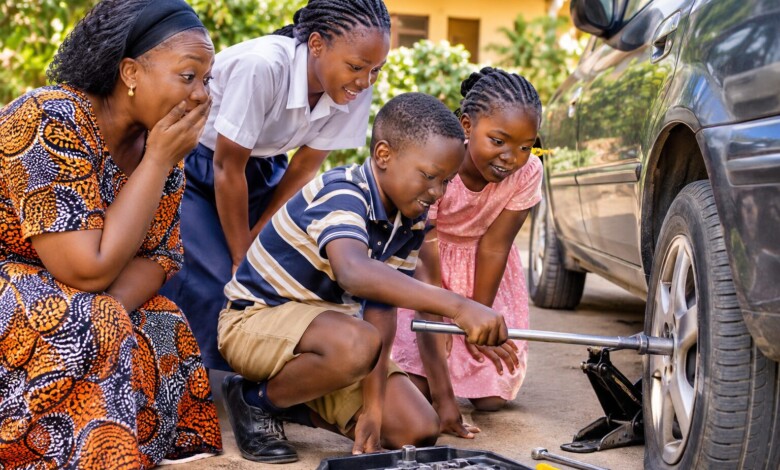
Her sixteen-year-old daughter, eight-year-old daughter and seven-year-old son stepped forward to change the tyre.
But what particularly caught her attention was the seven-year-old’s role. He knew exactly where the tools were kept, went to retrieve them, brought the necessary equipment, assembled what was needed and directed the process.
She was amazed!
As she reflected on what had just happened, she remembered that their father had always involved the children in his mechanical activities. They would accompany him, observe, assist and participate in their own little ways.
What the family had perhaps considered ordinary father-child interactions had actually become valuable learning experiences.
Without formal lessons or deliberate training sessions, the children had acquired practical knowledge through observation and participation.
This experience offers several important lessons for parents.
- Children learn even when we are not deliberately teaching.
The father may have been concentrating on repairing vehicles, but his children were learning along the way.
This reminds us that children constantly observe our actions, habits, attitudes and approaches to everyday responsibilities.
Sometimes, what we consider ordinary activities become extraordinary learning opportunities for our children.
- Involve children in everyday responsibilities.
The children in this story did not acquire their familiarity with mechanical tools overnight. Their father’s willingness to involve them created an environment in which learning happened naturally.
As parents, we should avoid excluding children from every practical activity simply because we can do things faster ourselves.
Involve them in cooking, gardening, household organisation, shopping and other age-appropriate activities.
Participation develops familiarity, confidence, cooperation and responsibility.
- Independence is nurtured, not demanded.
We often expect children to become responsible and independent without giving them sufficient opportunities to practise these qualities.
The experience of this family demonstrates the importance of gradual exposure, guidance and practice.
Children need opportunities to try, ask questions, make mistakes within safe boundaries and develop practical abilities.
Of course, potentially dangerous activities such as changing vehicle tyres must remain under responsible adult supervision.
- Never underestimate a child’s potential.
The seven-year-old’s ability to locate the tools and guide his older siblings is particularly noteworthy.
It reminds us that age alone does not determine a child’s ability to observe, remember, organise or demonstrate initiative.
Every child has unique abilities that need opportunities to emerge. Our responsibility is to recognise these abilities, nurture them and provide appropriate guidance.
- Fathers and mothers are both important learning influences.
The father’s involvement in mechanical activities had unintentionally created an opportunity for his children to acquire practical skills.
This should encourage both parents to recognise the influence of their everyday activities.
Let children see fathers and mothers demonstrating responsibility, competence, cooperation and service in different aspects of family life.
The home should be a shared learning environment where children develop the confidence and willingness to contribute.
THE BIGGER PICTURE
This mother’s experience reminds us that parenting extends beyond providing food, clothing, education and other necessities.
It also involves equipping children with the abilities, values and attitudes they need to navigate life.
We celebrate academic achievements, examination results and certificates, but we must equally appreciate practical competence, problem-solving, initiative, resilience and responsible character.
Dear parent, do not underestimate the little things you do with your children.
You may think you are simply repairing a vehicle, preparing a meal or organising your home. Yet, through these ordinary experiences, you could be nurturing abilities that become invaluable in your children’s adult lives.
Do not just prepare your children to enjoy the comfort you provide. Prepare them with the competence, confidence and character to navigate life responsibly.
Never underestimate the power of everyday parenting. What children learn while growing up may become their greatest resource when life presents unexpected challenges.