Ikrimah ibn Abi Jahl: From Islam’s fierce opponent to a courageous defender
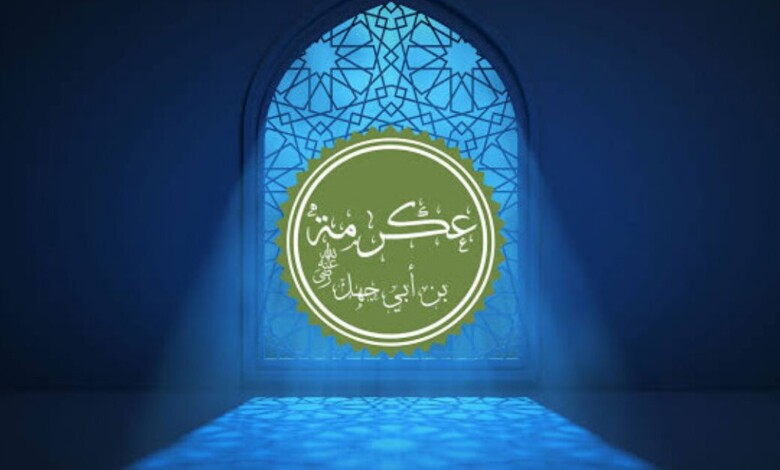
The story of Ikrimah ibn Abi Jahl is one of the most remarkable transformations in Islamic history.
Born into one of Makkah’s most influential families, he spent much of his early life opposing Prophet Muhammad and fighting against Islam. Yet, after embracing the faith, he became one of its most devoted supporters, eventually sacrificing his life on the battlefield.
His journey demonstrates that no one is beyond redemption and that sincere repentance can completely transform a person’s life.
Ikrimah’s father was Amr ibn Hisham, better known as Abu Jahl, one of the Prophet’s fiercest opponents. Abu Jahl earned the title “Father of Ignorance” because of his relentless hostility towards Islam.
BEFORE EMBRACING ISLAM
Growing up in the household of Abu Jahl, Ikrimah naturally inherited his father’s opposition to the Prophet. As Islam spread through Makkah, he became one of the young Quraysh leaders determined to stop the new religion.
He participated in the persecution of Muslims and fought against them in several major battles.
At the Battle of Badr in 624 CE, Ikrimah fought alongside the Quraysh army. The battle ended in a crushing defeat for Makkah, and his father was among those killed. The loss hardened his resolve, and he continued fighting Muslims at the Battle of Uhud the following year and later during the Battle of the Trench (Al-Khandaq).
Although he remained a determined enemy of Islam, historical accounts describe him as brave and disciplined, qualities that would later serve him well after his conversion.
HIS CONVERSION TO ISLAM
The turning point came during the Conquest of Makkah in 630 CE.
Following years of conflict, the Prophet Muhammad declared a general amnesty for the people of Makkah. However, a small number of individuals who had committed particularly serious crimes were initially excluded from that pardon, and Ikrimah was among them.
Fearing for his life, he fled towards the Red Sea, intending to seek refuge in Abyssinia.
Meanwhile, his wife Umm Hakim accepted Islam and appealed to the Prophet for mercy on behalf of her husband. The Prophet granted him protection.
Umm Hakim travelled after Ikrimah and caught up with him before he boarded a ship. She informed him that the Prophet had guaranteed his safety and urged him to return.
Ikrimah accepted her advice and returned to Makkah.
When he arrived, the Prophet welcomed him warmly, saying:
“Welcome, rider who has come in peace.”
Deeply moved by the Prophet’s mercy, Ikrimah embraced Islam and pledged his allegiance. He openly admitted his past mistakes and asked Allah for forgiveness.
The Prophet accepted his repentance without hesitation, setting an example that sincere repentance wipes away what came before it.
A NEW LIFE IN THE SERVICE OF ISLAM
Ikrimah’s conversion was genuine. He dedicated himself to making up for the years he had spent fighting Islam.
He took part in campaigns during the Prophet’s lifetime and, after the Prophet’s death, became one of the commanders who served under Caliph Abu Bakr during the Ridda (Apostasy) Wars.
Abu Bakr assigned him to help suppress rebellions that threatened the unity of the Muslim community. Although Ikrimah was known for his courage, some of his early decisions were criticised for being overly aggressive. He accepted Abu Bakr’s guidance and continued serving with discipline.
He later joined the Muslim armies campaigning in Greater Syria, where he fought alongside some of Islam’s greatest military commanders, including Khalid ibn al-Walid and Abu Ubaydah ibn al-Jarrah.
His life became a living example that true honour lies not in one’s ancestry but in faith and righteousness.
MARTYRDOM
Most early Muslim historians report that Ikrimah was martyred during the Muslim campaigns against the Byzantine Empire, although they differ on the exact battle. Many classical scholars place his death during the Battle of Yarmuk in 636 CE, while some earlier reports associate it with the Battle of Ajnadayn.
His death marked the final chapter in one of the most extraordinary stories of transformation in early Islam.