Magara videos stir Muslim unease over ‘Islamic’ claims

By Our Reporter
Videos circulating online in which convicted suspects in the Susan Magara murder case allegedly link the crime to Islam have stirred unease within Uganda’s Muslim community, with Muslim leaders questioning why the recordings were made and later circulated.
The controversy comes against a long-running backdrop in which Muslims have sometimes been associated with rebellion, terrorism and violent extremism. Muslim leaders and lawyers say the latest recordings risk reinforcing those perceptions by giving the impression that kidnapping and murder for ransom can be justified on religious grounds.
They insist there is no basis in the Quran or authentic Islamic teachings for such a claim.
Deputy Mufti Sheikh Muhammad Ali Waiswa and Uganda Muslim Supreme Council (UMSC) National Chairperson Prof. Dr Muhammadi Lubega Kisambira have condemned the alleged religious justification for Magara’s murder, describing it as false, dangerous and contrary to Islam.
Nine people were convicted by the High Court on August 3, 2026, over the 2018 kidnapping and murder of businesswoman Susan Magara, who was abducted for ransom before she was killed.
The emergence of the videos after the conclusion of the case has, however, shifted attention beyond the crimes themselves to questions about the circumstances surrounding the recordings and their subsequent circulation.

WHY WERE THE VIDEOS RECORDED?
For many Muslims, the central question is not whether the convicted suspects committed a crime, but why recordings appearing to link that crime to Islam were made and subsequently circulated.
The concern is particularly sensitive because the recordings appear to reinforce narratives that have, over the years, associated Muslims collectively with terrorism, rebellion and other forms of violent crime.
Muslim leaders say the actions of individual criminals should not be presented as evidence of Islamic doctrine or used to stigmatise an entire religious community.
Sheikh Waiswa said the Mufti’s Office is preparing a formal protest to the relevant authorities over the circulation of the recordings.
“The Mufti’s Office is soon writing a protest letter to the authorities questioning the motives of those behind the circulation of the videos,” he said.
He called for an investigation into the origin of the recordings and how they came to be circulated, warning that their continued dissemination could damage Uganda’s religious harmony.
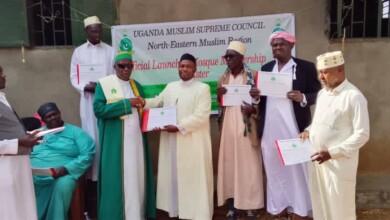
Sheikh Waiswa spoke during the burial of Hajjat Rukia Ndibaise, mother of Dr Sheikh Hassan Muhammad Mwaita, the UMSC General Assembly representative for Iganga Muslim District and Deputy Regional Assistant to the Mufti in charge of Busoga.
Hajjat Ndibaise was buried on Friday evening, August 7, at Nakalama Trading Centre in Iganga Muslim District.
Prof. Kisambira also questioned the attempt to associate Magara’s murder with Islam.
“We are not denying that Muslims commit crimes, but linking the high-profile murder of the late Susan Magara to the Islamic faith poses many questions,” he said.
He also questioned the circumstances surrounding the presentation of the convicted suspects, including their appearance in what he described as new Islamic attire when they received their sentences.
UMLAS CALLS FOR INVESTIGATION
The Uganda Muslim Lawyers’ Association (UMLAS) has also questioned the circumstances surrounding the recordings.
In a statement signed by its president, Rashid Ssemambo, the association said the videos risk creating a false impression that Islam condones kidnapping and murder for ransom.
“The convicts’ statements in the video recording are not founded in Islamic teachings nor are they to be found anywhere in the Holy Quran,” UMLAS said.
The association called on security agencies to investigate the circumstances surrounding the recording and its release and establish the motive behind its circulation.
“We appeal to all the security agencies in Uganda to conduct a comprehensive investigation into this occurrence to understand its objectives and the agenda it seeks to promote,” UMLAS said.
UMLAS said the videos could fuel Islamophobia by associating criminal conduct with Islam.
WHAT DOES ISLAM SAY ABOUT CAPTIVES?
Muslim leaders said Islamic teachings on captives and warfare cannot be used to justify the criminal kidnapping of civilians for financial gain or their unlawful killing.
They said Islam prohibits the unlawful taking of innocent life and places strict ethical requirements on the treatment of captives. Rules concerning ransom or the release of captives in the context of legitimate warfare belong to a specific legal framework and cannot be equated with kidnapping for profit.
The leaders cautioned Muslims and the wider public against treating statements attributed to convicted criminals as authoritative representations of Islamic theology.
The Mufti of Uganda, Sheikh Shaban Mubaje, has similarly described the alleged religious justification as “false, criminal and heretical”, saying there is no Quranic basis for kidnapping people for ransom and killing them.
Mubaje also questioned why the woman appearing in the recording did not cite a Quranic verse to support the alleged religious justification.