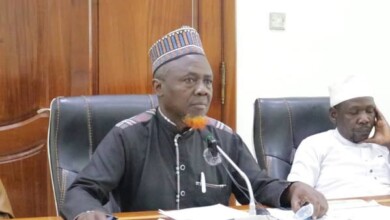
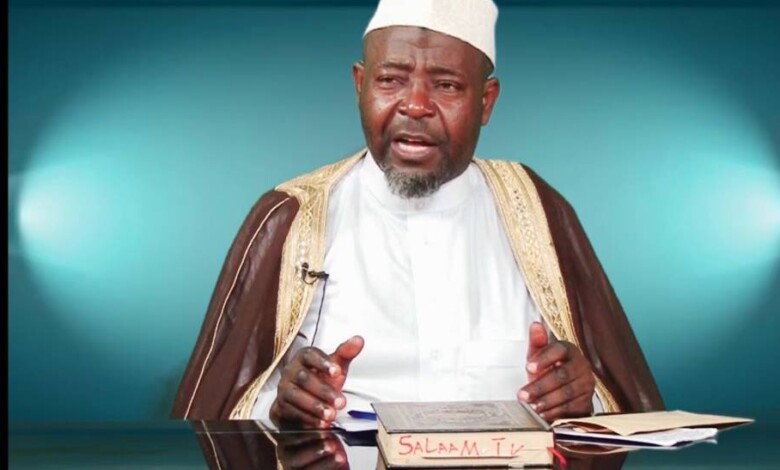
Sheikh Luswaabi: A life of Da’wah, a test of patience
By Sarah Nalule
For years, Sheikh Idris Habiib Luswaabi was a familiar and reassuring voice in Ugandan homes, using the airwaves to remind Muslims to turn to Allah, strengthen their faith and contribute to the development of Islam.
From Voice of Africa and Pearl FM to Salam TV, his voice was a constant presence. He also travelled to mosques, particularly in and around Kampala, where he serves as a district Kadhi under the Office of the Supreme Mufti.
But the voice that once reached thousands of listeners is now largely confined to a bedroom.
For about three years, Sheikh Luswaabi has been bedridden as complications arising from diabetes have progressively weakened his health.
The cleric was diagnosed with diabetes in 2006 but continued with his religious work for years. His health took a dramatic turn around 2020 when he was involved in a motor accident while travelling to an early-morning radio show on Voice of Africa.
He was later flown to the United States for treatment and returned to Uganda after undergoing an amputation of his right foot.
Since then, his condition has continued to deteriorate.
Although confined to his bed, Sheikh Luswaabi continued to share his message with Muslims. Crews from Salam TV and Akaboozi ku 2 radio would visit him at home to record his sermons, which aired on Sunday evenings and Friday afternoons respectively.
But even that has now become increasingly difficult.
Until a few months ago, he could still sit upright. However, after developing complications affecting his spinal cord, Sheikh Luswaabi can no longer sit. He has also lost his sight and undergone amputations of both legs.
PLIGHT
Last week, Sheikh Yasin Ssekikubo, host of the Muslim Roundtable podcast, brought Luswaabi’s plight to public attention by launching a drive to raise financial support for the cleric.
“The costs have become too high for him to handle,” Ssekikubo told The Friday Call on September 9.
“His weekly expenditure is above Shs 600,000, covering two dialysis sessions on Tuesdays and Saturdays, as well as medication and other related costs,” he added.
Ssekikubo learnt about Sheikh Luswaabi’s condition from his former classmate, Sheikh Swalahudiin Luswaabi, who is also the cleric’s son. Swalahudiin had shared a video showing his father undergoing one of the dialysis sessions.
“I became emotional. I was touched seeing the Sheikh in that condition, and I told myself that I must do something to help him,” Ssekikubo said.
During the one-hour podcast, Sheikh Luswaabi remained lying on his bed, unable to sit upright. His physical condition was visibly frail, but his voice remained firm as he spoke about patience and accepting Allah’s will.
“The condition I am in is a test for me, but because my parents taught me patience, I accepted what Allah willed for me. I implore the people out there to be patient, whatever hardships they are going through,” he said, referring to Surat Al-Imran, verse 200.
Despite his prolonged illness and mounting medical expenses, Sheikh Luswaabi remains grateful to those who have stood by him.
He singled out Prince Kassim Nakibinge and Imam Kasozi as among the biggest contributors towards his treatment. Imam Kasozi, for instance, covered the cost of his dialysis sessions for the whole of last year.
BIOGRAPHY
Born in 1966 to Habiib Kibuuka and Zaituni Namuli Nalule of Kyamimbi, in present-day Kayunga district, Luswaabi’s journey in education began at Bukuju Primary School, a low-grade school established by his grandfather, Zakaria Nsubuga.
Because the school had few religious instructors, he was sent in 1971 to Lukalu Quran School in Butambala, where he studied under Sheikh Abdul-Hamid Hassan Kayongo.
By 1975, he had completed his Quranic studies but remained at Lukalu to pursue Islamic jurisprudence until 1978, when he moved to Nakatonya-Bombo to continue his studies under Sheikh Muhammad Kimera.
In 1980, he joined the historic Nsotoka Islamic Primary School in Kayunga, completing the first level of his religious education in 1983.
That same year, he briefly enrolled at Bilal Islamic Institute, then located at Bat Valley in Kampala, before transferring to Bugembe Islamic Institute in Jinja.
“We couldn’t afford the tuition fees at Bilal, and Hajji Idris Ssentamu secured for me a vacancy to study at Bugembe,” Luswaabi recalled.
He graduated from Bugembe in 1984 with an Idaad certificate and secured a scholarship to study at the Islamic African Centre in Khartoum, Sudan, later renamed the International University of Africa. He graduated with a Thanawi certificate in 1988.
In 1990, he returned to Khartoum to pursue a Bachelor’s degree in Education and Social Studies, specialising in Arabic language. After graduating in 1993, he enrolled for a Diploma in Education and later completed a Master of Arts in Education, specialising in Arabic.
“I was on course to get a scholarship for my doctoral studies, but it did not materialise, so I returned to Uganda to teach at Mariam High School, Buziga Islamic Theological Institute and Bilal Islamic Institute, Kakiri,” Luswaabi said.
In 1999, he joined the Islamic University in Uganda (IUIU), initially teaching at its main campus in Mbale before settling at the Kampala Campus in Kibuli.
As his health began to deteriorate, he gradually reduced his workload.
“When I got weaker in 2015, I stopped going to Bilal and Mariam High School and remained at IUIU Kampala Campus and Kakungulu Memorial School,” he said.
He was also among the preachers at Kibuli Mosque, but his work in Da’wah took him far beyond Uganda, with preaching missions that saw him travel to different parts of the world.