The last salute to Gen. Moses Ali
By Jafar Mugera
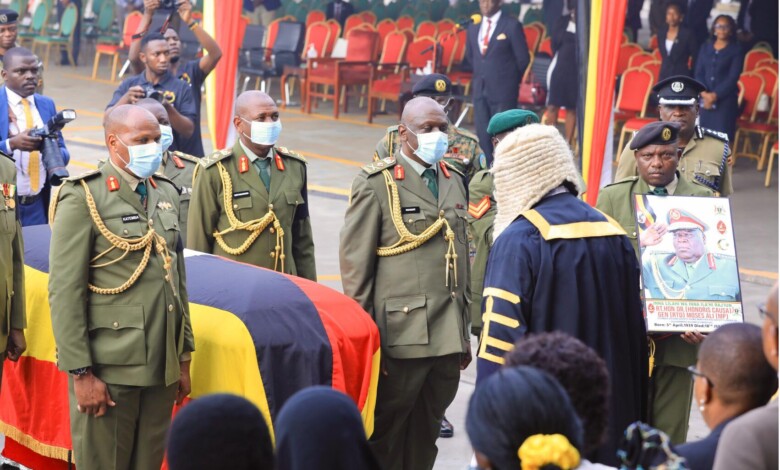
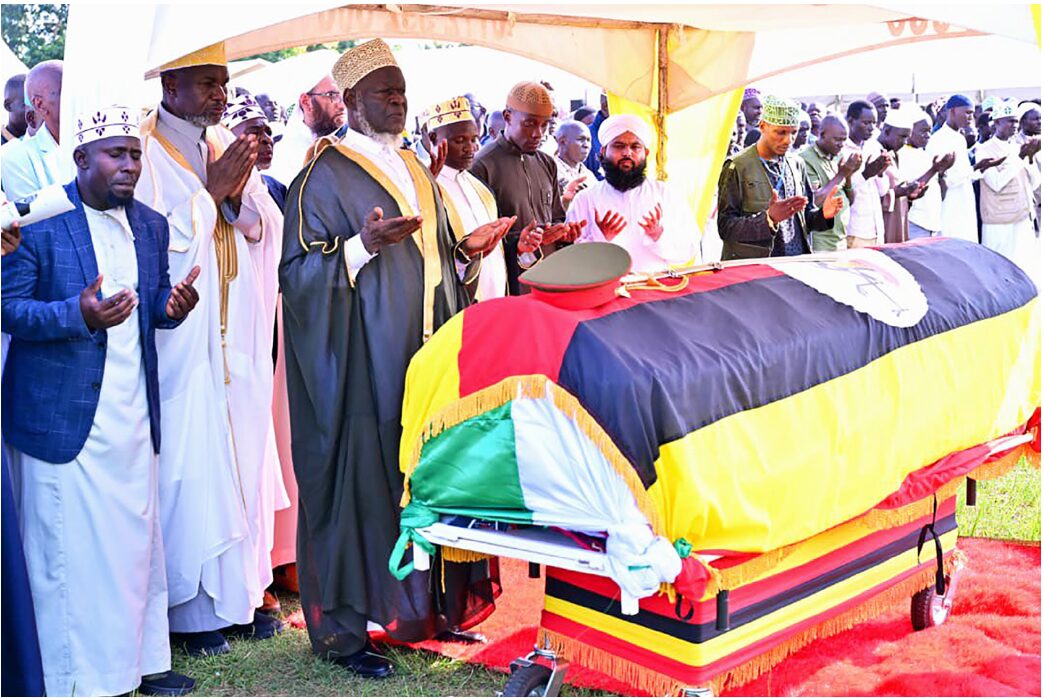
At exactly 5:25pm on July 22, the body of Gen. Moses Ali was lowered into the grave at Masjid Taqwa Muslim Cemetery in Abirichaku cell, Adjumani Town Council. His burial combined full military honours, ordered by President Yoweri Museveni, with solemn Islamic funeral rites.
The nation had been thrown into mourning on July 18 following the death of the veteran soldier, politician and elder statesman whose public service spanned more than five decades. For Uganda’s Muslim community, Gen. Ali was not only a senior government official but also one of its most distinguished sons, admired for his unwavering Islamic faith, humility and lifelong commitment to the welfare of Muslims.
His stature was reflected in an extraordinary tribute rarely accorded to any Muslim leader in Uganda. The country’s two parallel Muslim administrations at Kibuli and Old Kampala each held Salat al-Janazah in his honour, accentuating the respect he commanded across religious and institutional divides.
Throughout his life, Gen. Ali maintained cordial relations with Muslim leaders. Whether at Kibuli, Old Kampala or other Islamic centres across the country, he consistently championed unity, dialogue and cooperation for the common good of the Muslim community.
“He was a peacemaker, a nationalist, a politician and, above all, a good Muslim. We bear witness to that,” Prince Kassim Nakibinge said during funeral prayers at Kibuli Mosque on July 19.
Born in Adjumani District in the West Nile sub-region, Gen. Moses Ali rose to national prominence in the early 1970s after President Idi Amin appointed him Minister of Provincial Administration before later serving as Minister of Finance. The two fell out in 1978, prompting Gen. Ali to go into rebellion and establish the Uganda National Rescue Front (UNRF). He returned to government in 1989 after the UNRF signed a peace agreement with the National Resistance Movement (NRM). Throughout his time in government, he also became a strong supporter of Muslim causes and institutions.
“I got to know him in 1977. I was still a toddler, but I often saw him coming to our home to consult my late father, Prince Badru Kakungulu,” Nakibinge said.
From Kibuli, the funeral procession proceeded to the Uganda Muslim Supreme Council (UMSC) headquarters at Old Kampala, where the Mufti of Uganda, Sheikh Shaban Ramathan Mubaje, paid tribute to Gen. Ali’s pivotal role in the formation of UMSC and his efforts to strengthen Muslim institutions and advance the welfare of Muslims in Uganda.
“Gen. Moses Ali will be remembered not only as a national leader but also as a committed son of the Muslim community whose dedication to the development of Islamic institutions helped shape the future of generations of Ugandans,” the Mufti said.
FACTIONLESS
On July 21, Gen. Ali’s body was taken to Parliament, where President Museveni described him as a peacemaker whose contribution to Uganda’s political stability and the development of the West Nile sub-region would remain etched in the nation’s history.
The President also praised Gen. Ali for remaining above sectarian divisions within the Muslim community.
“He also advanced the interests of the Muslim community and never belonged to any of the factions. That is why his body was taken to both Kibuli and Old Kampala for prayers,” Museveni said.
This was reflected in his final farewell. Before the main ceremony at Padiri stadium in Adjumani, Sheikh Juma Vuni, the third deputy Supreme Mufti, led Salat al-Janazah at Masjid Taqwa. Later the body was moved to the stadium, where Sheikh Mubaje, presided over the final funeral prayers.
Gen. Ali is credited to have used his influence in government to champion projects that transformed the Muslim community. He was instrumental in supporting the establishment of the Islamic University in Uganda (IUIU), the construction of the Gaddafi National Mosque and the development of several other Islamic institutions.
credited him with leaving an enduring legacy.
“Gen. Moses Ali was the mind behind the construction of the Gaddafi Mosque, the Islamic University in Uganda and many other Muslim institutions,” said the Third Deputy Prime Minister Rukia Nakadama.
Over the years, Gen. Ali secured scholarships for numerous Ugandan students to pursue studies both within the country and abroad.
“My sister studied at Bombo Secondary School, and she told me she knew Gen. Moses Ali by the number of students he was supporting. She thought the entire school had its fees paid by him,” Nakadama said.
Among the beneficiaries of Gen. Ali’s education support programme are the State Minister for Veteran Affairs Huda Oleru and Obongi MP Hassan Kaps Fungaroo.