Zayd ibn Harithah: The Companion whose name appears in the Qur’an
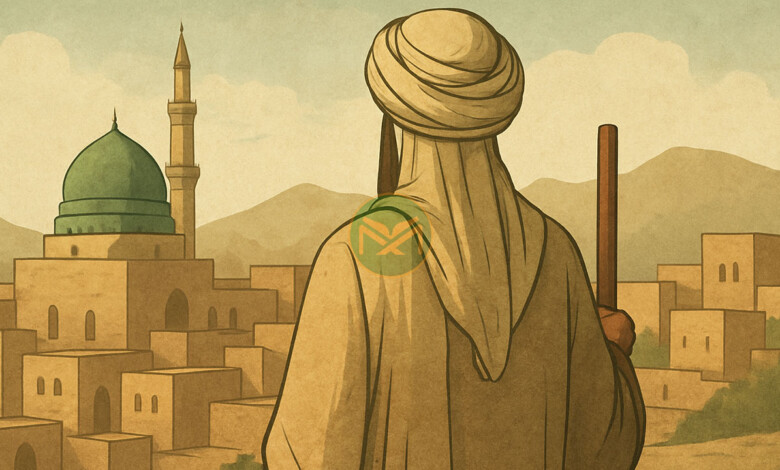
Among the many Companions of Prophet Muhammad, Zayd ibn Harithah holds a special place in Islamic history. He was not only one of the earliest people to embrace Islam but also the only Companion whose name is explicitly mentioned in the Holy Qur’an.
Zayd’s name appears in Surah Al-Ahzab, verse 37, in connection with the marriage of Prophet Muhammad to Zaynab bint Jahsh, following her divorce from Zayd.
Allah says:
“So when Zayd had no longer any need for her, We married her to you so that there would be no difficulty upon the believers concerning the wives of their adopted sons when they no longer have need of them. And the command of Allah must be carried out.” (Qur’an 33:37)
His story is one of loyalty, sacrifice and a remarkable relationship with the Prophet, who regarded him as one of the people dearest to him.
FROM CAPTIVITY TO FREEDOM
Zayd ibn Harithah ibn Sharahil al-Kalbi was born into the Banu Kalb tribe. As a young boy, he was captured during a raid and eventually taken to Makkah, where he was sold into slavery.
He was purchased by Khadijah bint Khuwaylid, who later gave him to Prophet Muhammad before their marriage.
The Prophet freed Zayd and treated him with great affection. When Zayd’s father, Harithah, and his uncle eventually discovered that he was in Makkah, they travelled there to take him home.
The Prophet did not stand in their way. Instead, he gave Zayd the freedom to choose between returning to his family and remaining with him.
Zayd chose to stay.
His decision deeply moved the Prophet, who subsequently declared him his adopted son. From then on, he was known as Zayd ibn Muhammad.
The bond between the two remained strong throughout their lives. Zayd was among the first people to embrace Islam when the Prophet began his mission and remained a trusted member of his household.
THE QUR’AN RESTORES HIS FAMILY NAME
Zayd’s adoption became significant in the development of Islamic family law.
Before Islam, Arab society recognised adoption in a manner that allowed an adopted child to assume the name and legal status of his adoptive father, including certain consequences associated with biological parenthood.
Islam established a distinction between caring for and raising an adopted child and changing that child’s biological lineage.
In Surah Al-Ahzab, Allah instructed Muslims to identify adopted children by their biological fathers:
“Call them by their fathers; that is more just in the sight of Allah.” (Qur’an 33:5)
Consequently, Zayd was no longer referred to as Zayd ibn Muhammad but resumed his father’s name, Zayd ibn Harithah.
The change did not diminish the affection between him and the Prophet. Rather, it clarified the distinction between biological lineage and the responsibility of caring for another person’s child.
HIS MARRIAGE TO ZAYNAB BINT JAHSH
Another important chapter in Zayd’s life involved his marriage to Zaynab bint Jahsh, a cousin of the Prophet.
The Prophet arranged the marriage, which was also significant in challenging the social distinctions that existed between Arabs of different backgrounds and social standing.
However, the marriage encountered difficulties, and Zayd eventually decided to divorce Zaynab. The Prophet had advised him to retain his wife, but the marriage eventually ended.
After Zaynab completed her waiting period, Allah commanded the Prophet to marry her. This was intended to establish that the former wife of an adopted son was not subject to the same marriage prohibition as the former wife of a biological son.
The event is recorded in Surah Al-Ahzab, verse 37, and explains why Zayd’s name appears in the Qur’an.
MARTYRDOM AT THE BATTLE OF MU’TAH
Zayd’s life came to an end during the Battle of Mu’tah in 8 AH (629 CE), in present-day Jordan.
The Prophet appointed him commander of the Muslim army, with Ja’far ibn Abi Talib designated to take over if Zayd fell, followed by Abdullah ibn Rawahah.
The instructions were clear: if one commander was killed, the next would assume leadership.
Zayd carried the Muslim banner into battle and was killed fighting. Ja’far subsequently took command and was also martyred, followed by Abdullah ibn Rawahah.
The three commanders appointed by the Prophet lost their lives in the battle, but their leadership became part of the enduring history of the early Muslim community.
The Prophet later spoke of the deaths of the three commanders with deep sadness.
Zayd left behind his son Usamah, who would go on to become one of the most respected young military leaders of the early Muslim community.